
Guide
A paid status is not proof. Financial closure explained.
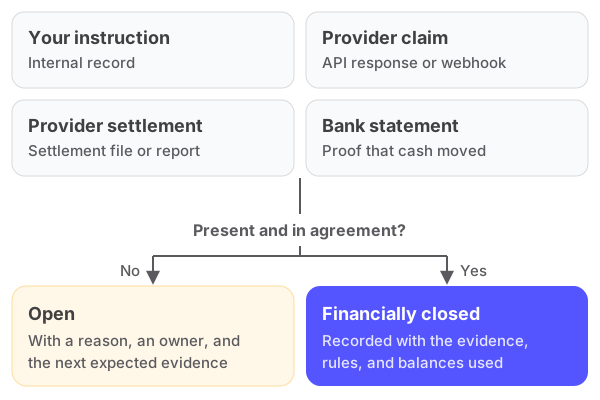
Financial closure is the point at which a payment is proven: every leg finished, every expected piece of evidence present and in agreement, and nothing left in transit.
Last updated:
See the architectureWhat is financial closure?
A payment is financially closed when it is proven, not just reported. Every part of the payment has finished. Every piece of evidence it should receive is present and agrees. Every settlement that covers it has been accepted. Its ledger postings balance, nothing is left in transit, and no money-affecting exception is open.
Why is paid not the end?
Once a status reaches paid, many systems stop asking questions. Nothing obliges anyone to prove that the money settled, or to say what is still open. Unfinished payments then build up quietly, and nobody owns them.
A paid status is a claim from one provider. Financial closure asks for independent proof, usually the bank movement behind the provider’s settlement.
The six closure conditions
- Every leg of the payment plan is finished (completed, failed, cancelled, or reversed), and no attempt is still in progress or unknown.
- Every leg has received the evidence its provider profile says it should, and that evidence agrees.
- Every leg that should be settled is covered by an accepted settlement.
- The payment’s ledger postings balance, and its in-transit position is zero.
- No money-affecting exception is open against the payment or its settlements.
- If the payment failed or was reversed, the sender’s refund or non-collection is itself evidenced and posted.
What keeps a payment open?
- EXECUTING
- A leg is still being carried out.
- AWAITING_SETTLEMENT
- The payout completed, and the settlement that pays for it has not been accepted yet.
- AWAITING_EVIDENCE
- An expected file, statement, or callback has not arrived.
- EXCEPTION_OPEN
- A break has been found and has an owner working on it.
- LEDGER_UNBALANCED
- The postings do not balance, or money is still in transit.
- REOPENED_BY_EVIDENCE
- New evidence arrived after the payment had closed.
What happens when evidence arrives after closure?
A payment can be closed correctly and still change later. A provider may reverse a payout days afterwards, or a corrected file may arrive. The payment is then reopened, the new evidence is reconciled, corrective postings are made, and the payment closes again under the same conditions. History is never edited: the earlier closure and the reason for reopening both stay on record.
Payment closure and business-day closure
Closing a payment and closing a business day are separate. A day closes when every expected file has arrived or is listed as missing, every payment for that day is closed or open with an owned reason, every expected settlement is accepted or listed, and balances agree with settlement and cash evidence. A day never closes by ignoring an exception.
A payment collected at 23:59 on one side and paid out at 00:01 on the other belongs to two business days, one in each calendar. That is not a break when both views explain it.
How Flominzo records closure
Closure in Flominzo is recorded as an event with the evidence items, rule versions, and ledger balances it relied on. Until then, a payment is open with a reason, an owner, and the next event it is waiting for.
Sources
Let’s make it specific to you.
Bring your systems, payment flows, and questions. We’ll help define the next step.
Talk to the team