
Use case
Your bank changes its statement format. Reconciliation keeps reading it.
When a bank moves from MT940 to ISO 20022 camt.053, or changes fields and cut-off times, the new format is proven against the old one before a day is closed on it.
Last updated:
Discuss a format changeAt a glance
Use caseThis page describes how Flominzo handles this situation. It is not a report of a specific customer’s results.
- Typical team
- Treasury, finance, and banking operations
- Flominzo product
- Flominzo Recon
- Deadline set by
- Your bank’s release schedule
- Stays with you
- Bank relationship, cutover date, change approval
The situation
Banks change statement formats on their own schedule: a move from SWIFT MT940 to ISO 20022 camt.053, a new intraday camt.052 report, longer reference fields, or a different cut-off time. Every source that reads those statements has to follow.
A statement change rarely fails loudly. A truncated reference or a shifted cut-off surfaces days later as a wave of breaks, or as a day closed without the evidence it needed.
Why it goes wrong
- A field is truncated, so references stop matching and every payment looks unexplained.
- A new cut-off moves transactions to a different business day, creating false breaks.
- A file fails to parse and nobody notices that the evidence never arrived.
What you send us
- The bank’s change notice and sample files in the new format.
- Files in the old format for the same days, if the bank can provide both.
- The date the bank will switch.
How the change is handled
Statement parsing lives behind the adapter boundary, configured by a Rail Profile, so the reconciliation engine never changes.
- Identify: find every evidence source that reads this bank’s statements from the declared evidence sources.
- Configure: add the new format to the Rail Profile as a new version: layout, field mappings, time zone, and cut-off.
- Prove equivalence: parse the same days in the old and the new format and confirm they produce the same canonical statement records.
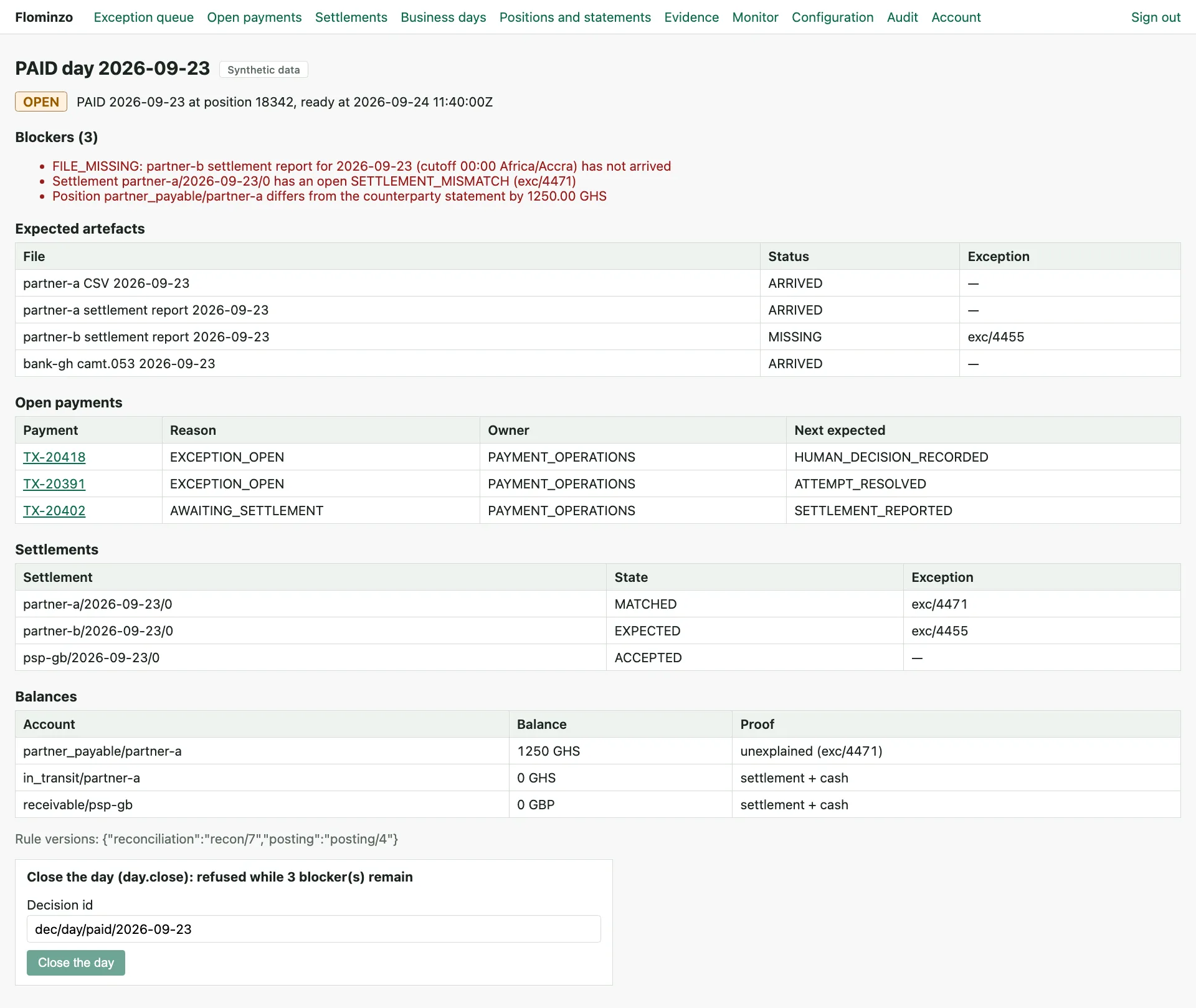
- Fail loudly: a file that cannot be parsed is kept and recorded as rejected, and a file that does not arrive by its cut-off raises FILE_MISSING. Neither is silently skipped.
- Switch on the bank’s date: the profile version takes effect from the bank’s cutover, with the previous version kept for older files.
What you receive
- A versioned Rail Profile change with the equivalence results for each sample day.
- A list of any fields the new format no longer provides, and how matching uses them.
- Business days that close on complete evidence, before and after the switch.
Decisions that stay with you
- Your relationship and agreements with the bank.
- The cutover date and any parallel-run period.
- Approval of the change.
Where this lives in Flominzo
Let’s make it specific to you.
Bring your systems, payment flows, and questions. We’ll help define the next step.
Talk to the team